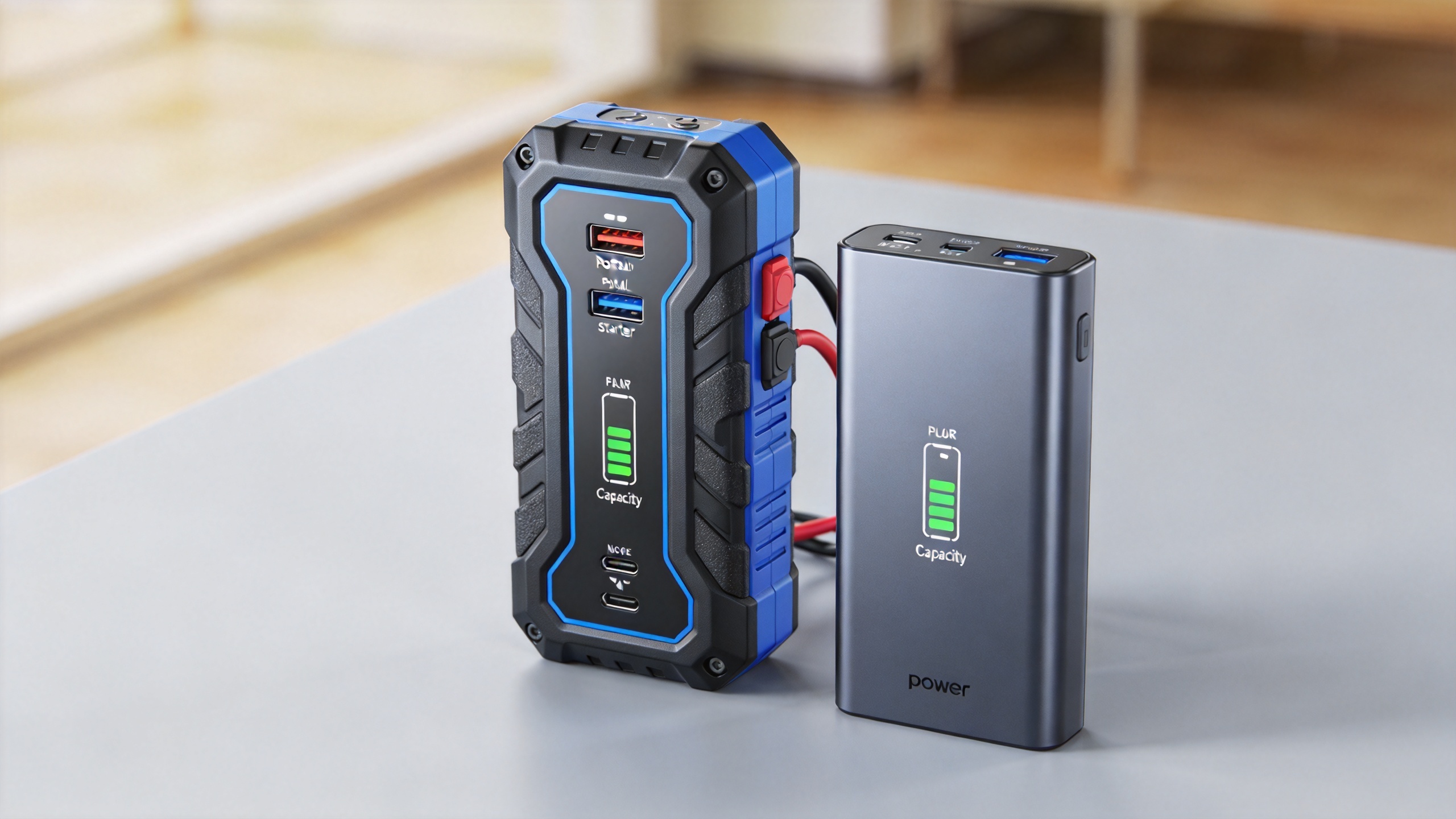
Choosing between a dedicated emergency tool and a mobile charging solution is a common dilemma for modern drivers. Understanding the fundamental jump starter vs power bank distinction is essential, as these devices are engineered for entirely different electrical outputs and safety protocols.
Jump Starter vs Power Bank: Understanding the Capacity Differences: at a glance
When comparing a jump starter to a standard power bank, the primary difference lies in the "C-rate" or discharge rate. A power bank is designed to provide a steady, low-amperage flow of electricity to charge a smartphone or tablet over several hours. In contrast, a jump starter is engineered to release a massive burst of current—often hundreds or thousands of amps—in a fraction of a second to turn over a heavy internal combustion engine.
While both devices use lithium-ion or lead-acid battery chemistry, their internal architecture is distinct. A jump starter contains high-discharge cells capable of handling the extreme thermal stress of a cold-cranking event. A power bank, even a high-capacity one, would likely suffer a thermal runaway event or permanent cell damage if forced to provide the cranking amps required to start a vehicle.
- Jump Starters: Optimized for high-amperage, short-duration bursts.
- Power Banks: Optimized for low-amperage, long-duration energy delivery.
- Safety Protocols: Jump starters include reverse-polarity protection and spark-proof clamps; power banks lack these automotive-specific safety features.
Head-to-head: Architecture and Performance
To truly grasp why these devices are not interchangeable, we must look at the specific engineering of top-tier units. A device like the [NOCO Boost X GBX55] is built with specialized internal circuitry that monitors the state of the car battery and provides a "pre-boost" handshake before releasing power. This prevents damage to the car's sensitive ECU (Electronic Control Unit).
On the other hand, a standard consumer power bank lacks the heavy-gauge cabling and the intelligent clamp system required to bridge the gap between two batteries. If you attempt to use a power bank to start a car, the internal voltage regulator will likely cut power immediately to protect the device from the massive back-feed of current coming from the car’s alternator or battery.
- High-Performance Jump Starters: [GOOLOO GT4000 Arctic] and [NOCO Boost Max GB250] use advanced lithium-polymer cells designed for extreme temperature fluctuations.
- Professional Reliability: Units like the [Clore Automotive JNC770R] and [Clore Automotive JNC660] use AGM lead-acid technology, providing a different type of power delivery that is often preferred by mechanics for its sheer durability.
- Compact Versatility: Devices like the [AstroAI S8 Ultra] offer a middle ground, providing enough power for light-duty jump-starting while maintaining a portable footprint.
Pricing: Investing in Reliability
When evaluating the cost, you are paying for the safety features and the quality of the battery cells. A cheap power bank might cost $30, but it will never have the capacity to start an engine. Conversely, a high-end unit like the [NOCO Boost X GBX155] commands a higher price because it is built to handle massive diesel engines and includes proprietary safety technology that prevents user error.
If you are looking for a bargain, you might consider the [NOCO Boost GB40] or the [Primedura DM1264], which offer a balance of price and performance for the average passenger vehicle. However, for professional-grade reliability, the price jumps as you move into the territory of the [NOCO Boost GB150] or [NOCO Boost GB70], which are designed for frequent use in demanding environments.
- Entry-level: Generally under $100; suitable for small engines and occasional use.
- Mid-range: $100–$250; offers faster charging speeds and higher peak amperage.
- Professional: $250+; designed for heavy-duty trucks, fleets, and daily roadside assistance.
Who Should Pick Which
The decision should be dictated by your primary use case. If your goal is to keep your devices charged during a camping trip, a high-capacity power bank is the correct tool. If your goal is to ensure you are never stranded with a dead car battery, a dedicated jump starter is an absolute necessity.
Many drivers make the mistake of thinking that a "large" power bank can double as a jump starter. This is a dangerous misconception. If you drive a truck or an SUV, you should look at [Top Rated Portable Jump Starters for SUVs and Trucks] to ensure your gear has the cranking power to handle the high compression of those engines.
- Choose a Power Bank if: You only need to charge phones, cameras, and laptops.
- Choose a Jump Starter if: You own a vehicle and want to be self-reliant during roadside emergencies.
- Hybrid Users: Some modern jump starters include USB-C PD (Power Delivery) ports, allowing them to function as a high-capacity power bank for your electronics, effectively giving you the best of both worlds.
The Importance of Cranking Amps
Cranking Amps (CA) and Cold Cranking Amps (CCA) are the metrics that define a jump starter. A power bank has no "Cranking Amp" rating because it isn't designed to move a starter motor. When browsing for a device, look at the specifications of the [GOOLOO GP4000] or similar high-output units. These devices are rated by their ability to kick over an engine in sub-zero temperatures.
If you live in a climate with harsh winters, you need a device that is specifically rated for low-temperature operation. The [GOOLOO GT4000 Arctic] is a prime example of a device engineered to maintain its discharge efficiency even when the mercury drops, which is a feature you will never find in a standard consumer power bank.
- Gas Engines: Typically require less peak amperage.
- Diesel Engines: Require significantly higher peak amperage due to the high-pressure fuel systems and glow plug requirements.
- Always check the manufacturer's engine size limit: A unit designed for a 3.0L engine will fail to start a 6.0L diesel engine.
Safety Features: The Hidden Value
The most significant difference in the jump starter vs power bank debate is the safety suite. A jump starter is essentially a "smart" battery. It includes sensors that detect if the clamps are connected to the wrong terminals (reverse polarity), if the clamps are touching each other (short circuit), or if the car battery is already damaged.
Devices like those found in [The 8 Best Portable Jump Starters for 2026] come equipped with these safety protections as standard. A power bank, if shorted, can vent gas, catch fire, or explode. When you buy a reputable jump starter, you are buying a complex management system that prevents these catastrophic failures.
- Reverse Polarity Protection: Prevents sparks when clamps are reversed.
- Over-Charge Protection: Ensures the internal cells don't degrade when left on a charger.
- Thermal Protection: Shuts the unit down if it gets too hot during a cranking attempt.
Maintenance and Longevity
Jump starters require more care than power banks. Because they are lead-acid or high-discharge lithium, they need to be kept charged. A lead-acid unit like the [Clore Automotive JNC770R] should be kept plugged in when not in use to prevent the battery from sulfating. Lithium-based jump starters like the [NOCO Boost X GBX55] should be checked every 3-6 months to ensure they maintain a sufficient charge for an emergency.
If you neglect a jump starter, it will eventually lose its ability to hold a charge, rendering it useless when you need it most. Treat your jump starter as a critical piece of safety equipment, similar to a fire extinguisher or a spare tire.
- Storage: Keep in a dry, temperature-controlled environment.
- Charging: Follow the manufacturer's recommendations for storage voltage.
- Inspection: Regularly inspect the cables for fraying or corrosion.
Choosing the Right Tool for Your Vehicle
When using our [Portable Jump Starter Finder], you should filter your results based on your vehicle type. A sedan needs significantly less power than a commercial van or a heavy-duty pickup. If you are unsure of your engine's requirements, always err on the side of more power.
For those who want to compare the top models side-by-side, we recommend reviewing [The Best Portable Jump Starters of 2026] and [The Best Portable Jump Starters for 2026: Expert Tested]. These resources provide deep dives into how these units perform under real-world conditions, helping you avoid the common pitfalls of buying an underpowered device.
- Check your manual: Look for your engine's displacement (liters) and fuel type (gas/diesel).
- Consult the guide: Use [The 8 Best Professional-Grade Portable Jump Starters of 2026] if you are a professional or own multiple heavy-duty vehicles.
- Read the reviews: Focus on how the device handles "cold start" scenarios.
Frequently Asked Questions
Can I use a high-capacity power bank to jump-start my car?
No. Even if the power bank has a high capacity (measured in mAh), it lacks the necessary discharge rate (amperage) to turn over a starter motor. Attempting to do so will likely damage the power bank's internal circuitry and may pose a fire risk.
What happens if I connect a jump starter backward?
Modern jump starters, such as the [NOCO Boost GB40], feature reverse-polarity protection. If you connect the clamps to the wrong terminals, the device will simply beep or flash a warning light and refuse to output power, preventing damage to both the jump starter and your vehicle's electrical system.
How often should I recharge my portable jump starter?
Lithium-ion jump starters should be checked every three to six months. If the charge level has dropped below 50%, you should top it off. Lead-acid jump starters, like the [Clore Automotive JNC660], should ideally be kept on a trickle charger or recharged immediately after every use to maintain battery health.
Is a jump starter with an air compressor worth it?
If you frequently travel or drive long distances, a combo unit can be a lifesaver. It allows you to handle both dead batteries and low tire pressure. You can learn more about these versatile tools in [The Ultimate Guide to Portable Jump Starters with Air Compressors].
Do I need a professional-grade jump starter for a standard sedan?
Generally, no. A standard consumer-grade unit like the [AstroAI S8 Ultra] is more than sufficient for most passenger cars. Professional-grade units are designed for high-frequency use, heavy-duty engines, and extreme environments where reliability under stress is the highest priority.
Why do some jump starters cost significantly more than others?
The price difference usually reflects the quality of the internal battery cells, the inclusion of smart safety features, the peak amperage output, and the build quality of the clamps and cables. Higher-priced units are also more likely to be rated for extreme weather conditions and offer faster internal recharging times.
Verdict
The jump starter vs power bank debate is settled by one simple fact: purpose. A power bank is for convenience; a jump starter is for survival. While it is tempting to save money by purchasing a device that claims to do both, your vehicle's electrical system deserves the protection and power that only a dedicated, high-amperage jump starter can provide.
Before making a purchase, assess your specific vehicle’s needs by reviewing [The Best Portable Jump Starters for 2026]. By choosing a reputable, tested model, you ensure that when you turn the key, the engine starts, regardless of the temperature or the state of your car battery. Invest in quality, keep your device charged, and enjoy the peace of mind that comes with being prepared for the unexpected.