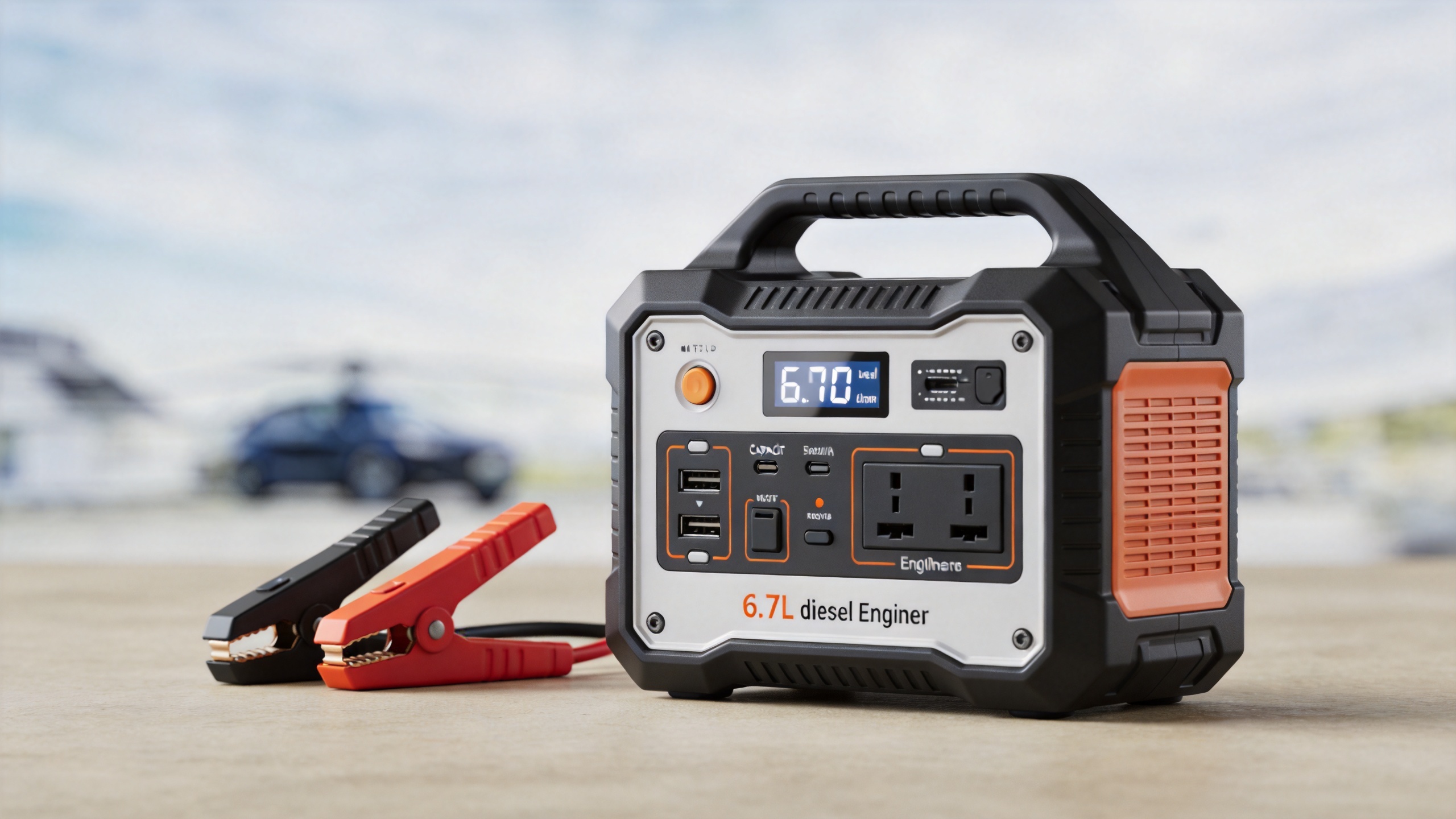
Starting a 6.7L diesel engine requires significantly more cranking amperage than a standard gasoline motor, making the selection of a jump starter a critical task. If you choose an underpowered unit, you risk damaging your electronics or simply failing to turn over the heavy-duty engine when you need it most.
High-Capacity Jump Starters for 6.7L Diesel Engines: at a glance
When dealing with a 6.7L Power Stroke, Cummins, or Duramax engine, you are fighting against high compression ratios and massive internal friction. Unlike a 2.0L four-cylinder engine, these motors demand a massive "cold cranking" burst of energy to get the pistons moving. A standard consumer-grade jump pack designed for a compact sedan will likely fail, either by blowing a fuse or refusing to engage the starter solenoid.
The best [portable jump starter for 6.7 diesel](/articles/best-portable-jump-starters-suvs-trucks) engines must prioritize peak current (measured in Amps) and battery chemistry (usually Lithium LiFePO4 or high-discharge Lithium-Polymer). You aren't just looking for a battery that holds a charge; you are looking for a device capable of delivering a massive surge of power in under three seconds.
Key features to look for:
- Peak Amperage: Aim for units rated at 2,000 to 4,000+ Amps.
- Safety Protections: Reverse polarity protection, spark-proof technology, and over-current protection are non-negotiable for expensive diesel engine computers.
- Build Quality: Diesel trucks are often used in rugged environments; look for IP65 water resistance and rubberized, shock-absorbent housings.
- Cable Thickness: Heavy-duty 8-gauge or thicker cables are required to transfer the high current without melting the insulation.
Understanding Cold Cranking Amps (CCA) vs. Peak Amps
There is often confusion between the "Peak Amps" advertised on jump starter boxes and the "Cold Cranking Amps" (CCA) required by your truck’s battery. Peak Amps represents the absolute maximum current the jump starter can provide for a split second. CCA represents the current a battery can provide at 0°F for 30 seconds.
For a 6.7L engine, the starter motor might pull 600–900 Amps during the initial engagement. If your jump starter is rated for 1,000 Peak Amps, it might struggle in freezing temperatures. This is why you should always aim for the highest capacity unit you can afford.
Factors influencing your choice:
- Ambient Temperature: Batteries lose significant power in cold weather.
- Battery Health: If your truck’s battery is completely dead (0 volts), the jump starter has to do 100% of the work.
- Engine Condition: A well-maintained engine turns over easier than one with worn-out glow plugs or old oil.
The Role of Lithium Technology in Diesel Jump Starting
Modern portable jump starters have moved away from heavy lead-acid batteries toward Lithium-ion and Lithium-iron-phosphate (LiFePO4) chemistries. These are lighter, hold a charge for months, and provide a much higher discharge rate, which is perfect for the "short, sharp shock" required to start a large diesel engine.
However, lithium batteries are sensitive to extreme cold. If you live in a climate where temperatures drop below zero, you must store your jump starter inside the cab rather than in the truck bed or an external tool box.
Advantages of Lithium:
- High Energy Density: Significant power in a small, portable package.
- Low Self-Discharge: You can leave them in your glove box for six months and they will still have 80% charge.
- Fast Charging: Most units now use USB-C PD (Power Delivery) to recharge in under two hours.
Head-to-head: NOCO Boost X GBX45 vs. GBX55 vs. GBX75
When comparing the NOCO Boost X series, the primary differentiator is the "X" factor—the ability to deliver power to a dead battery. The GBX series is designed specifically for high-compression engines.
- NOCO Boost X GBX45: This is the entry-point for smaller diesels. While it can handle some 6.7L scenarios, it is right at the edge of its capability. It is best used if the vehicle battery has some residual charge.
- NOCO Boost X GBX55: This is a more balanced choice. It offers more overhead for cold starts and is generally considered the minimum "safe" bet for a 6.7L engine.
- NOCO Boost X GBX75: This is the powerhouse. If you are in a remote area or dealing with extreme cold, the GBX75 provides the necessary headroom to ensure the engine turns over on the first attempt without straining the internal cells.
Pricing: Is higher capacity worth the cost?
The price gap between a 2,000-Amp unit and a 4,000-Amp unit is usually between $80 and $150. When you consider the cost of a tow truck or the risk of being stranded in a remote location, the extra investment is almost always justified for 6.7L diesel owners.
Budgeting considerations:
- The "One and Done" Cost: Buying a unit that is too weak forces you to buy a second, stronger unit later.
- Feature Creep: Many expensive models include LED flashlights, USB-C charging ports for phones, and DC output ports. Decide if you need these "extras" or if you just want a pure jump-starting tool.
- Warranty Value: Higher-end units often come with better manufacturer support and longer warranty periods, providing peace of mind for an expensive piece of equipment.
Who should pick which?
Choosing the best portable jump starter for 6.7 diesel is about matching your usage patterns to the equipment.
- The Daily Commuter: If you drive your truck daily and the battery is generally healthy, the NOCO Boost X GBX55 is likely sufficient. It stays compact in your console and handles the occasional dead battery with ease.
- The Off-Roader/Rancher: If you are working in remote areas, towing heavy loads, or using the truck in freezing climates, go with the NOCO Boost X GBX75. The extra capacity is insurance against the harsh conditions that kill batteries.
- The Fleet Manager: If you are buying these for a fleet of trucks, the GBX75 is the professional choice. It is robust enough to handle the abuse of multiple users and consistently starts large-displacement engines.
Essential Safety Protocols for Diesel Jump Starting
Jump starting a diesel engine is not the same as a small car. The currents involved are high enough to cause serious injury or damage if done incorrectly. Always follow the sequence: connect the positive clamp to the positive terminal, then the negative clamp to a solid chassis ground (not the negative terminal of the dead battery, if possible).
Safety checklist:
- Clear the Area: Ensure no one is touching the vehicle when the starter is engaged.
- Check for Corrosion: If the battery terminals are heavily corroded, the jump starter will not be able to bridge the connection effectively. Clean them first.
- Wait for the Glow Plugs: In a diesel, turn the key to the "on" position and wait for the glow plug light to extinguish before attempting to jump start. This ensures the engine is ready to fire.
Maintenance of Your Jump Starter
Even the best portable jump starter for 6.7 diesel engines needs care. Because these are lithium-based, they do not like to be stored at 0% or 100% for long periods.
- Quarterly Top-off: Check the charge level every three months.
- Storage Temperature: Never store in temperatures exceeding 120°F (like a hot dashboard in summer) or below 0°F.
- Cable Inspection: After every use, wipe down the clamps to remove any battery acid or debris that could corrode the metal.
Frequently Asked Questions
Can I use a 1,000-Amp jump starter on a 6.7L diesel?
Technically, it might work if the battery is only slightly discharged. However, it is not recommended. A 6.7L engine requires high initial cranking amps, and a 1,000-Amp unit is likely to trigger its internal safety shutoff or suffer from significant voltage drop, leading to a failed start.
Does the jump starter need to be fully charged to start a diesel?
For the best results, yes. Jump starters deliver their highest amperage when they are above 75% charge. If your unit is at 20%, it may not have the "burst" capacity required to overcome the compression of a large diesel engine.
Will jumping a diesel truck damage the jump starter?
If you follow the instructions and use a high-quality unit like the NOCO Boost X series, it is safe. The risk comes from short-circuiting the clamps or leaving the jump starter connected to the truck after the engine has started, which can force current back into the jump starter.
How many times can I jump start a truck on one charge?
This depends on the health of the truck's battery and the temperature. Generally, a high-capacity unit can perform 3–5 starts on a single charge. However, you should always recharge the unit immediately after a successful start to ensure it is ready for the next emergency.
Do I need to disconnect my truck's dead battery?
No. In fact, it is usually better to leave the dead battery connected. It acts as a buffer for the electrical system. The jump starter provides the initial surge to turn the starter motor, and once the engine is running, the alternator takes over.
Conclusion
Selecting the right equipment for a 6.7L diesel engine is a balance of power, reliability, and preparedness. While there are many options on the market, focusing on high-amperage units like the NOCO Boost X series ensures that you aren't left stranded. By prioritizing a unit with sufficient peak current and maintaining it properly, you can ensure your truck starts reliably regardless of the conditions. Always remember that the best portable jump starter for 6.7 diesel is the one that is charged, accessible, and powerful enough to handle the demands of your engine on the first turn of the key.