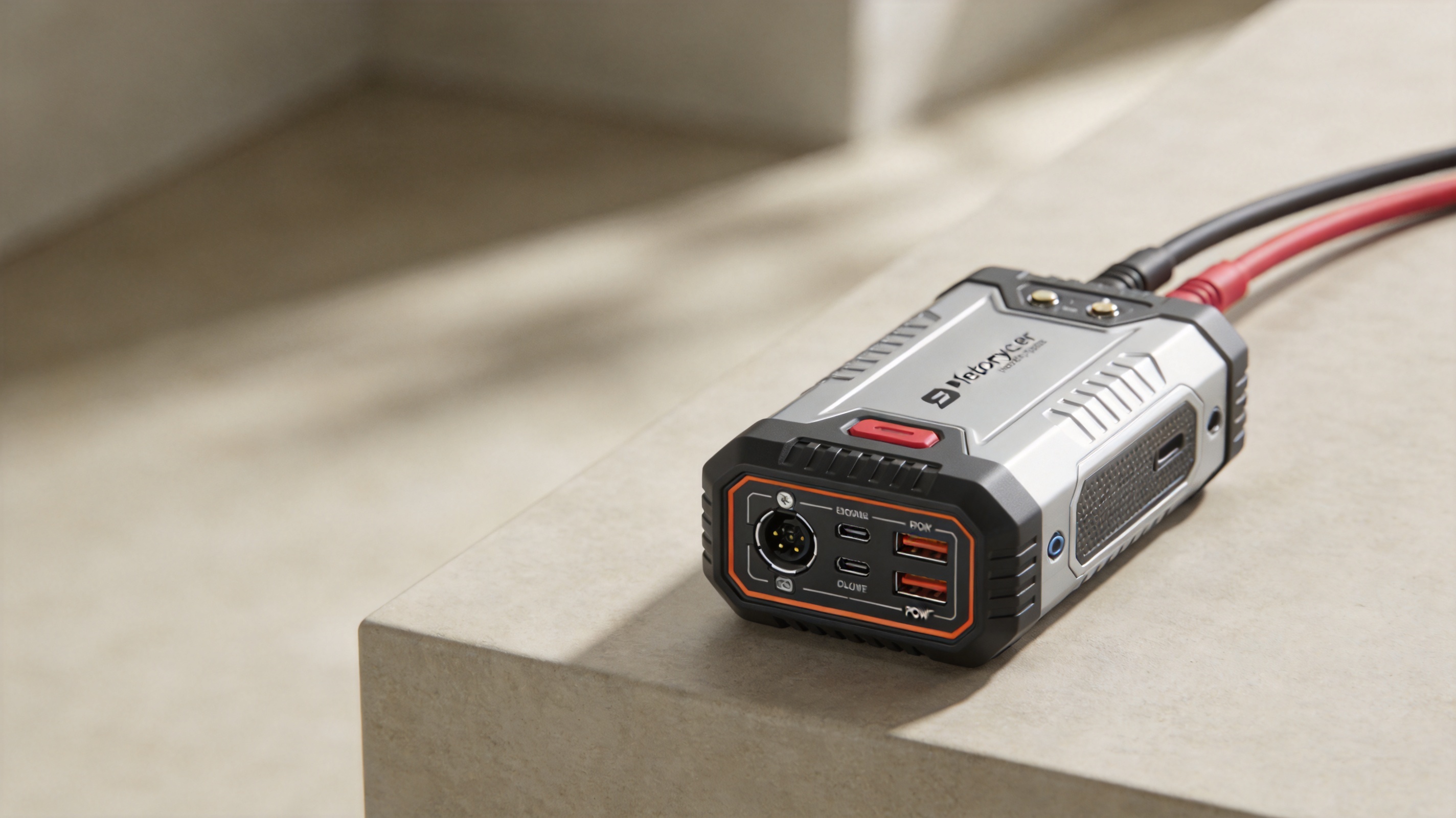
Finding yourself stranded with a dead battery on a motorcycle, ATV, or snowmobile is a unique kind of frustration. Unlike a car, you cannot simply flag down a stranger for a jump start, and the cramped battery compartments of powersports vehicles make traditional jumper cables almost useless.
The best portable jump starter for motorcycles is a compact, high-discharge lithium power bank designed specifically to bridge the gap between small-engine requirements and the portability needed for a saddlebag or backpack. This guide will walk you through the technical nuances, safety considerations, and specific model comparisons to ensure you never get stuck on the side of the road again.
Understanding Lithium Power for Powersports
Traditional lead-acid batteries are heavy and require constant maintenance, but modern lithium jump starters have revolutionized roadside recovery. These devices use Lithium-Cobalt or Lithium-Polymer chemistry, which allows for a massive "burst" of amperage in a package no larger than a smartphone. For motorcycle owners, this is a game-changer because these units can be stored in a tank bag or under a seat without adding significant weight.
When shopping for a jump starter, you aren't just looking for "power"; you are looking for peak current (Amps) and capacity (milliamp-hours or mAh). Motorcycles typically require a lower cold-cranking amp (CCA) burst than a V8 truck, but the internal protection circuitry must be sensitive enough to handle the smaller, more delicate electrical systems found on modern fuel-injected bikes.
- Peak Amps: The maximum burst of electricity the unit can provide for a few seconds.
- Capacity (mAh): How many times you can jump the vehicle or charge your devices before the jump starter needs a recharge.
- Safety Protections: Essential features like reverse polarity protection, short-circuit prevention, and spark-proof technology.
Best Portable Jump Starters for Motorcycles and Powersports: at a glance
When selecting the right unit, we focus on three distinct categories: the ultra-compact "emergency-only" units, the mid-range "all-rounder" power banks, and the heavy-duty units capable of jump-starting large cruisers or side-by-sides.
- The Ultra-Compact: These are designed for minimalist riders who prioritize space. They often lack extra bells and whistles but provide a reliable, single-use punch.
- The Power-User: These units include USB-C PD (Power Delivery) charging, integrated LED flashlights, and enough capacity to charge a phone or tablet multiple times.
- The Heavy-Duty: Designed for larger displacement engines (1500cc+) or multi-cylinder powersports vehicles that require a sustained, higher-amperage output.
Essential Features to Look For
Not all jump starters are created equal. When evaluating the best portable jump starter for motorcycles, you must look beyond the marketing claims. The quality of the "smart clamps"—the cables that connect to your battery—is often more important than the battery capacity itself.
Look for clamps that feature heavy-duty copper jaws and a robust plastic housing. Cheap, flimsy clamps can create high resistance, which prevents the jump starter from delivering the necessary current to the starter motor. Furthermore, check for IP ratings if you plan on doing off-road or adventure riding, as moisture and dust resistance are critical for long-term reliability.
- Smart Clamps: Must have built-in safety indicators (LED lights) to warn you if you have connected the positive and negative terminals incorrectly.
- USB-C Input/Output: Fast charging for your devices and faster recharging for the jump starter itself.
- Operating Temperature Range: Ensure the unit is rated to perform in cold weather, as batteries lose significant cranking power when temperatures drop.
Head-to-head: Comparing Performance
Comparing jump starters requires looking at how they handle "real world" conditions. A unit might be rated for 2000 Amps, but if that power isn't delivered efficiently due to thin wiring or poor connection points, it will fail to turn over a cold engine.
When comparing units, focus on the "C-rating" or the discharge rate. A high-quality lithium cell can discharge rapidly without overheating. Cheaper units often suffer from "voltage sag," where the output drops the moment you hit the starter button, causing the jump starter's protection circuit to trip prematurely.
- Efficiency: Does the unit maintain voltage under load?
- Build Quality: Is the casing impact-resistant? (Crucial for motorcycles where vibrations are constant).
- Cable Length: Longer cables are often better for motorcycles, as battery terminals can be buried deep under bodywork.
Pricing: What to Expect
You can find jump starters ranging from $40 to over $200. The pricing usually correlates with the quality of the lithium cells and the sophistication of the internal Battery Management System (BMS).
For a dedicated motorcycle jump starter, the "sweet spot" is typically between $70 and $120. In this range, you get reliable, high-density cells, robust safety protections, and useful extra features like fast-charging USB ports. Avoid the "bargain bin" units under $40, as they often use recycled or low-grade cells that lose capacity quickly and may not provide the necessary burst current when your battery is truly dead.
- Entry Level: Basic functionality, limited accessories, lower cycle life.
- Mid-Range: Best value, high-quality components, versatile for charging gadgets.
- Professional/Heavy Duty: Highest capacity, ruggedized casings, often include air compressors or higher-wattage power outputs.
Who should pick which
Your riding style should dictate your purchase. If you are a long-distance tourer, you need a unit that doubles as a power bank for your GPS, phone, and Sena headset. If you are a track-day rider or a local commuter, you want the smallest, lightest unit possible that can live in your tail bag without you ever noticing it.
- The Adventure Rider: Needs a rugged, weather-resistant unit with high capacity and fast-charging capabilities.
- The Minimalist/Sportbike Rider: Needs the smallest unit possible; capacity is secondary to pure cranking power.
- The Side-by-Side/ATV Owner: Needs a higher-capacity unit capable of handling larger engines and potential auxiliary loads.
Safety and Maintenance
Lithium jump starters are safe, but they are not "set it and forget it" devices. Because they are chemical batteries, they require periodic attention to ensure they remain functional when you actually need them.
Always store your jump starter in a cool, dry place. Extreme heat (like a motorcycle trunk in direct summer sun) is the enemy of lithium batteries. Additionally, make it a habit to check the charge level every 3–6 months. A jump starter that has been sitting at 0% for a year will likely be permanently damaged and unable to hold a charge.
- Maintenance Tip: Charge your jump starter to 100% after every use.
- Storage Tip: If you keep it on your bike, ensure it is in a padded compartment to dampen vibrations.
- Safety Tip: Never leave the jump starter connected to the battery after the engine has started.
Proper Jump-Starting Technique
Even the best portable jump starter for motorcycles will fail if used incorrectly. The sequence of connection is vital. Always connect the positive (red) clamp to the positive terminal first, then the negative (black) clamp to a ground point on the engine block or frame (if possible), rather than the negative battery terminal. This reduces the risk of sparks near the battery, which can vent hydrogen gas.
Once the connections are secure, turn on the jump starter, wait a few seconds for the power to stabilize, and then crank the engine. Do not crank for more than 5 seconds at a time. If the bike doesn't start, wait 30 seconds to let the jump starter recover before trying again.
- Step 1: Connect Red to Positive.
- Step 2: Connect Black to Ground/Frame.
- Step 3: Turn on the unit and wait for the "Ready" light.
- Step 4: Crank the engine.
- Step 5: Disconnect in reverse order.
FAQ: Common Questions Answered
Can I use a car jump starter on a motorcycle?
Yes, you can, provided the jump starter is "smart." Modern jump starters automatically detect the voltage of the battery. However, car units are often physically too large to carry on a motorcycle. Ensure the unit is compatible with 12V lead-acid batteries, which almost all modern portable jump starters are.
How often should I recharge my portable jump starter?
Even if you haven't used it, you should top off the charge every 3 to 6 months. Lithium batteries have a low self-discharge rate, but they lose capacity over time if left in a depleted state.
Will a jump starter damage my bike's sensitive electronics?
High-quality jump starters with "smart" safety features are designed to regulate the voltage and prevent spikes. Cheap, non-regulated units can potentially cause issues, which is why it is critical to buy from reputable brands that include reverse-polarity and surge protection.
How many times can I jump my bike on a single charge?
This depends on the capacity (mAh) and the size of your engine. A quality unit should be able to provide 5–10 jump starts on a single charge for a standard motorcycle engine before needing a recharge.
Is it safe to leave a jump starter in my saddlebag?
Yes, but avoid extreme temperatures. If you live in an area with extreme summer heat, bring the jump starter inside when the bike is parked for long periods. If the unit gets too hot, the internal protection will prevent it from charging or discharging, potentially rendering it useless.
Verdict
The best portable jump starter for motorcycles is the one that is small enough to carry, powerful enough to turn over your specific engine, and reliable enough to work when the temperature drops. Do not base your decision solely on the highest "peak amp" rating; focus on the build quality of the clamps, the safety features of the internal circuitry, and the physical size of the unit.
Investing in a high-quality jump starter is a small price to pay for the peace of mind that comes with knowing you are self-sufficient on the road. Whether you are riding a small-displacement commuter or a massive touring bike, having a reliable lithium power source in your kit is an essential part of modern motorcycle ownership. Choose a unit that fits your storage constraints, keep it charged, and ride with the confidence that you won't be left stranded by a simple battery failure.