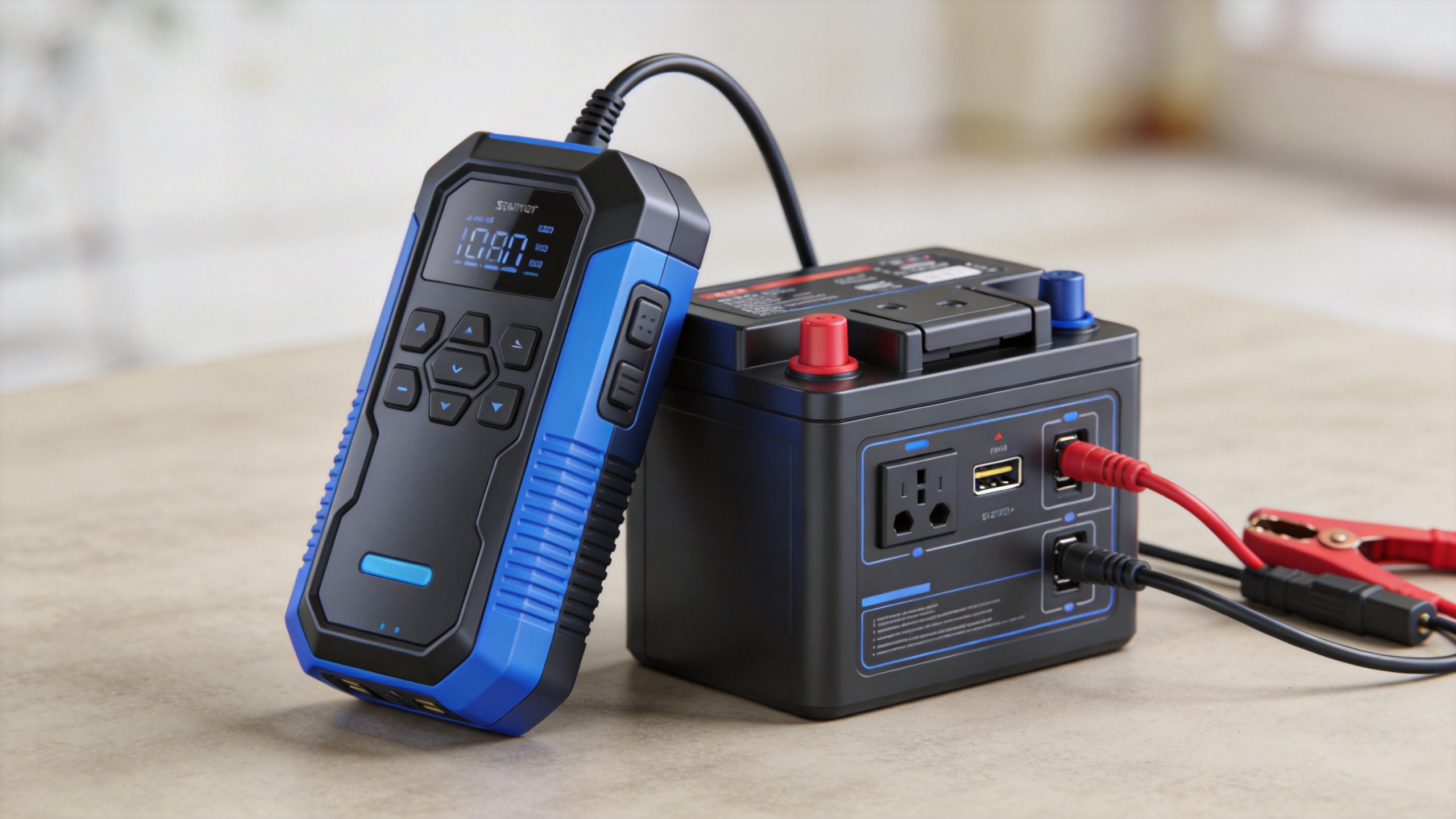
Choosing between emergency roadside gear can be confusing, especially when you are debating between a portable jump starter vs battery charger. While both tools aim to get your vehicle running again, they operate on fundamentally different principles and serve distinct purposes for the modern driver.
Portable Jump Starter vs Battery Charger: Which Tool Do You Need?: at a glance
The primary distinction lies in the nature of the "fix." A portable jump starter is designed for immediate, emergency recovery. It provides a massive burst of amperage to turn over a dead engine in seconds, allowing you to get back on the road without needing an external power source. It is a "get-out-of-jail-free" card for when your battery dies in a parking lot or on a remote trail.
In contrast, a traditional battery charger is a maintenance tool. It is designed to be plugged into a wall outlet (AC power) to slowly restore a battery's chemical charge over several hours. It is not an emergency tool for the side of the road, but rather a workshop essential for reviving a drained battery or keeping a vehicle that sits for long periods in a healthy state.
- Jump Starter: High-amperage, instant output, mobile-first design.
- Battery Charger: Low-amperage, sustained input, requires AC power.
- Use Case: Emergency start vs. long-term battery health maintenance.
Head-to-head: Understanding the Technology
Portable jump starters, such as the AstroAI S8 Ultra or the GOOLOO GT4000 Arctic, use high-discharge lithium-polymer battery technology. This chemistry allows the device to dump a significant amount of energy into the vehicle's starter motor in a short window. Because they are self-contained, they don't rely on the grid, making them the ultimate tool for mobility.
Battery chargers, conversely, are usually larger, heavier units that convert 120V AC household electricity into the 12V DC power required to charge a lead-acid or AGM battery. They are generally not designed to provide the "cranking amps" necessary to start a car immediately. While some modern "smart" chargers have a "jump start" or "engine start" mode, they still require an extension cord to reach your vehicle, which is rarely practical in a breakdown scenario.
When Portability is Non-Negotiable
If you are a commuter, a road-tripper, or someone who frequently heads off-grid, the debate of portable jump starter vs battery charger is easily settled in favor of the jump starter. You cannot plug a battery charger into a tree or a guardrail. Devices like the NOCO Boost X GBX55 are built specifically to be stored in a glove box or trunk, ready to deploy the moment you turn the key and hear that dreaded clicking sound.
- Convenience: Compact designs fit under seats or in spare tire wells.
- Safety: Most modern units are spark-proof and reverse-polarity protected, making them safer for the average user than traditional jumper cables.
- Versatility: Many units, like the GOOLOO GP4000, include USB ports for charging phones and tablets during an emergency.
Power Requirements and Vehicle Compatibility
Not all jump starters are created equal. You must match the capacity of the jump starter to the displacement of your engine. For example, a heavy-duty diesel engine will require significantly more power than a small four-cylinder sedan. This is where professional-grade units like the NOCO Boost Max GB250 or the NOCO Boost GB150 excel, as they are engineered for massive engines that would leave smaller, consumer-grade units struggling.
If you own a fleet of vehicles or live in an area with extreme temperatures, consider the GOOLOO GT4000 Arctic, which is specifically optimized for cold-weather performance. Lithium batteries often lose capacity in freezing temperatures, so choosing a unit rated for your specific environment is just as important as choosing one rated for your engine size.
Pricing: The Cost of Readiness
When looking at the price, you are paying for capacity and safety features. Entry-level jump starters are quite affordable, but as you move up to units like the NOCO Boost X GBX155, you are paying for higher peak current and more robust build quality.
- Entry-level: Generally under $100, suitable for small to mid-sized cars.
- Mid-range: $100–$200, offering better build quality and higher capacity for SUVs and light trucks.
- Professional: $250+, essential for large diesel engines and frequent, heavy-duty use.
Battery chargers, while often cheaper than high-end jump starters, are limited by their lack of mobility. You are essentially paying for a specialized power supply rather than a portable emergency power station.
The Role of Professional-Grade Equipment
For those who work on vehicles professionally, a "portable" jump starter might actually be a large, wheeled unit like the Clore Automotive JNC770R or the Clore Automotive JNC660. These units use heavy-duty lead-acid batteries, which provide massive cranking power and extreme durability. While they aren't meant to be carried in a backpack, they are the gold standard for repair shops and roadside assistance vehicles.
If you are looking for the best in the industry, checking The 8 Best Professional-Grade Portable Jump Starters of 2026 is a great way to see how these heavy hitters compare to the smaller, more consumer-focused lithium units.
Maintenance vs. Emergency: The Verdict
If your battery is dying because it is old, a jump starter is merely a temporary patch. You will eventually need a battery charger to condition the battery or, more likely, a new battery altogether. However, if your goal is to avoid being stranded, the jump starter is the only tool that belongs in your trunk.
For those who want to compare the latest and greatest, The Best Portable Jump Starters of 2026 provides a comprehensive look at the current market leaders. If you are specifically looking for something lightweight and reliable, The 8 Best Portable Jump Starters for 2026 is an excellent resource for narrowing down your choices.
Safety Features: Why Modern Units Win
One of the biggest advantages of modern portable jump starters, such as the NOCO Boost GB40 or NOCO Boost GB70, is the integration of safety logic. Older jumper cables were dangerous; if you touched the clamps together or connected them to the wrong terminals, you risked sparks, battery explosions, or electrical damage to your car's sensitive computer systems.
Modern jump starters feature:
- Reverse Polarity Protection: The unit will not output power if the clamps are connected incorrectly.
- Spark-Proof Technology: You won't get a dangerous flash if the clamps touch.
- Overload Protection: Prevents the unit from overheating during an intense start attempt.
Choosing the Right Tool for Your Vehicle
When deciding between a jump starter and a charger, evaluate your specific needs. Do you have a garage with power? A battery charger is a great investment for long-term vehicle storage. Do you spend a lot of time on the road? A jump starter is mandatory.
For more detailed comparisons, you can browse The Best Portable Jump Starters for 2026: Expert Tested or The Best Portable Jump Starters for Automotive Tools in 2026 to find the specific unit that fits your vehicle's engine size and your personal budget.
Frequently Asked Questions
Can a battery charger jump start my car?
Generally, no. Most home battery chargers provide a low current (2 to 10 amps) meant to charge a battery over several hours. To start a car, you need hundreds of amps instantly. Unless your charger has a dedicated "engine start" mode and is plugged into a wall, it will not start your car.
How often should I charge my portable jump starter?
Most modern lithium jump starters, such as the Primedura DM1264, have a low self-discharge rate. However, it is best practice to check the charge level every 3 to 6 months and top it off if necessary to ensure it is ready when an emergency strikes.
Are lithium jump starters safe to leave in a hot car?
While lithium batteries are more robust than they used to be, extreme heat can degrade their lifespan. It is best to store your jump starter in a location that avoids direct, prolonged sunlight, such as under a seat or in a trunk compartment, rather than on the dashboard.
Do I need a different jump starter for a diesel engine?
Yes, diesel engines typically require much higher cranking amps than gasoline engines of the same size. Always check the manufacturer's rating for the specific jump starter to ensure it is rated for your engine type and displacement.
What is the difference between peak amps and cranking amps?
Peak amps is the maximum theoretical current a device can produce for a split second. Cranking amps (or cold cranking amps) is a more realistic measure of the power the device can sustain to actually turn the starter motor. When shopping, prioritize the cranking amp rating over the peak amp rating.
Verdict
The "portable jump starter vs battery charger" debate is best resolved by recognizing that they are complementary, not competing, tools. For the average driver, a high-quality portable jump starter is an essential piece of safety equipment that provides peace of mind on every journey. A battery charger, while useful for home maintenance, cannot replace the immediate, life-saving utility of a jump starter when you are miles from home. Invest in a reliable jump starter first, and consider a battery charger only if you have a dedicated space to maintain your vehicle's battery health over the long term.