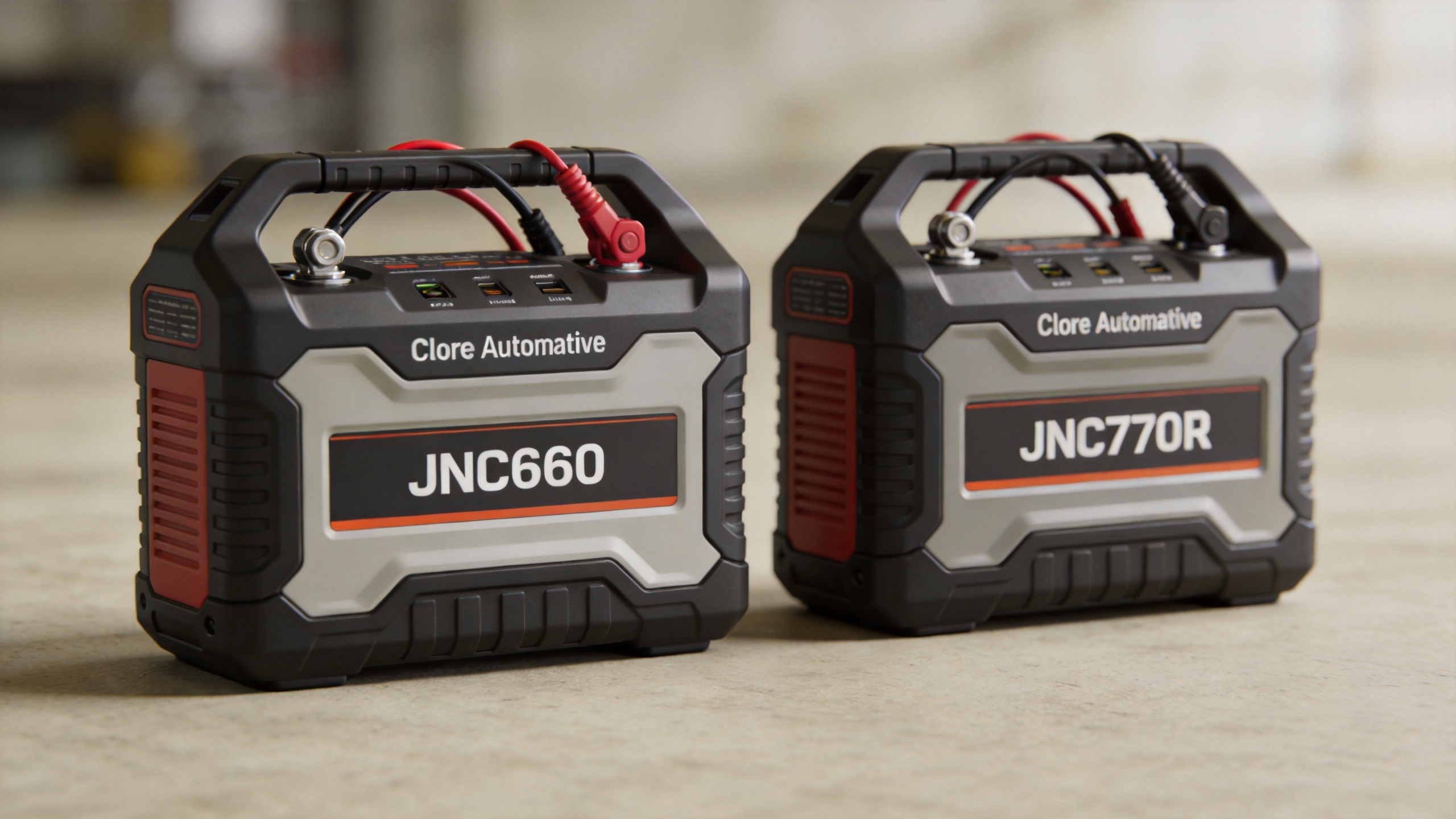
When professional mechanics and roadside assistance providers need reliable starting power, the debate often centers on the legendary Jump-N-Carry series. Choosing between the Clore Automotive JNC660 and the Clore Automotive JNC770R requires an understanding of how their specific power profiles and integrated features align with your daily workload.
Clore Automotive JNC660 vs JNC770R: Which Professional Jump Box Wins?: at a glance
The Clore Automotive JNC660 is widely considered the industry standard for traditional lead-acid jump starters. It is a no-nonsense, rugged tool that has built its reputation on simplicity and extreme durability. It provides high cranking amperage in a compact, manageable form factor that fits easily into any service vehicle.
In contrast, the Clore Automotive JNC770R represents an evolution of the platform. While it shares the same core philosophy of raw, lead-acid power, it introduces design refinements meant to improve user experience, such as enhanced cable management and slightly different output configurations. If you are comparing these for your shop, you are essentially choosing between the "tried-and-true" classic and the "modernized" professional workhorse.
- JNC660: The gold standard for basic, high-amperage professional starting.
- JNC770R: The ergonomic upgrade with refined cable storage and handling.
- Common Ground: Both use Clore's proprietary Proformer battery technology designed for long service life.
Head-to-head: Power and Performance
When evaluating the clore automotive jump-n-carry jnc660 vs jnc770r, the most critical factor is the cranking capability. Both units are designed to start a wide range of vehicles, from passenger cars to light-duty trucks, without the need for a donor vehicle. The JNC660 delivers 1,700 peak amps and 425 cranking amps, which is sufficient for almost any standard 12V engine.
The JNC770R offers a similar power pedigree but is often favored for its specific output characteristics during cold-start conditions. Because these are lead-acid units, they perform significantly better in freezing temperatures than many lithium-based alternatives like the NOCO Boost X GBX55 or the GOOLOO GP4000. When you are working in a shop environment where the unit stays in a cold bay, the lead-acid chemistry in these Clore units provides a level of consistency that lithium cannot match.
- Cold Cranking Performance: Superior to lithium units like the NOCO Boost GB40.
- Reliability: Both units feature heavy-duty industrial clamps that penetrate battery terminal corrosion effectively.
- Battery Chemistry: AGM/Lead-acid for sustained cranking power rather than short bursts.
Build Quality and Ergonomics
Professional tools live a hard life. They get dropped, dragged across concrete, and exposed to oil, grease, and extreme weather. The Clore Automotive JNC660 features a high-impact, impact-resistant case that has been the benchmark for decades. It is deceptively simple, but that simplicity is exactly why it lasts so long.
The Clore Automotive JNC770R takes the durability of the JNC660 and adds refined ergonomics. The handle design and the way the cables wrap around the unit are designed to reduce fatigue and prevent the "cable tangle" that often plagues busy technicians. If you are using your jump starter multiple times a day, the ergonomic differences in the JNC770R become apparent.
- Case Durability: Both feature impact-resistant, high-density polyethylene housings.
- Cable Management: The JNC770R offers a more intuitive wrap-around system for the heavy-duty cables.
- Weight: Both are substantial, emphasizing their professional-grade battery capacity.
The Role of Battery Technology
The primary reason professionals stick with Clore Automotive is the "Proformer" battery. Unlike the lithium-ion batteries found in the AstroAI S8 Ultra or GOOLOO GT4000 Arctic, these batteries are designed to be cycled thousands of times.
When you look at the clore automotive jump-n-carry jnc660 vs jnc770r, you are looking at two different iterations of the same battery philosophy. These batteries are designed to deliver massive amperage instantly, which is ideal for breaking the stiction of a frozen or seized engine. Lithium jump starters, while portable, often require a "pre-heat" or a specific "boost" mode to handle the same level of resistance, whereas the Clore units are "always ready."
- Cycle Life: Significantly higher than consumer-grade lithium units.
- Safety: No risk of thermal runaway or fire associated with damaged lithium cells.
- Maintenance: Both require regular charging to maintain battery health, unlike lithium units that can sit for months.
Pricing and Value Proposition
When comparing Clore Automotive JNC660 and Clore Automotive JNC770R, the price difference is usually reflective of the ergonomic features rather than a massive jump in raw power. For a shop owner buying in bulk, the JNC660 often provides the best return on investment because the core performance is identical to its more expensive sibling.
If you are a mobile mechanic or a roadside assistance driver, the extra cost for the JNC770R is effectively an insurance policy against frustration. Faster cable management and a more comfortable carry handle mean you spend less time setting up and more time getting the job done. For the average consumer looking for a garage unit, the JNC660 is almost always the better financial choice.
- JNC660 Value: Best for shops that need a reliable, no-frills workhorse.
- JNC770R Value: Best for high-frequency users who value speed and handling.
- Longevity: Both units offer a lower "cost per start" over five years than any consumer lithium starter.
Who Should Pick Which?
Deciding between these two units depends on your specific environment. If you operate in a static shop or a garage where the jump starter doesn't travel far from the workbench, the Clore Automotive JNC660 is the undisputed champion. Its widespread adoption in professional shops is a testament to its reliability and ease of repair.
However, if your work involves jumping vehicles in parking lots, on the side of the road, or in tight, awkward spaces, the Clore Automotive JNC770R is the better investment. The refined design makes a noticeable difference when you are rushing to get a customer back on the road in inclement weather.
- Choose JNC660 if: You want the most proven, cost-effective professional starter on the market.
- Choose JNC770R if: You prioritize ease of use, better cable organization, and ergonomic handling.
- Avoid if: You need a pocket-sized unit; for that, look at the NOCO Boost GB70 or similar lithium options.
Comparison to Modern Lithium Alternatives
It is impossible to discuss the clore automotive jump-n-carry jnc660 vs jnc770r without acknowledging the rise of lithium-based units. Products like the NOCO Boost X GBX155 or NOCO Boost Max GB250 offer incredible portability and features like USB-C charging and LED flashlights.
However, these lithium units are generally designed for "emergency use" rather than "professional service." If you are a professional, you are likely jumping multiple cars a day. The lead-acid chemistry in the Clore units can handle this repetitive abuse far better than lithium, which may experience degradation if discharged and recharged constantly. If you need something for occasional use in a small car, lithium is fine, but for heavy-duty service, stick with the Clore units.
- Lithium: Great for portability and emergency kits.
- Lead-Acid (Clore): Great for high-frequency, daily professional use.
- Hybrid approach: Many pros carry a JNC unit for the shop and a Primedura DM1264 or similar for emergency road calls.
Maintenance for Long-Term Reliability
Both the Clore Automotive JNC660 and the Clore Automotive JNC770R require one simple thing to last for years: consistent charging. Because these are lead-acid batteries, they suffer from "sulfation" if left in a discharged state for too long.
To get the most out of your purchase, follow these rules:
1. Charge immediately after use: Never leave the unit in a depleted state.
2. Monthly top-offs: Even if you haven't used the unit, plug it in once a month to keep the battery chemistry active.
3. Store in a dry place: While they are rugged, moisture can corrode the internal connections over time.
For more insights on choosing the right tools, check out our guide on The 8 Best Professional-Grade Portable Jump Starters of 2026 to see how these units compare to the broader market.
Verdict: The Professional Choice
After analyzing the clore automotive jump-n-carry jnc660 vs jnc770r, it is clear that both units are exceptional pieces of equipment. The JNC660 remains the king of value, providing everything a professional needs without any unnecessary fluff. It is the unit that has kept millions of vehicles running for decades, and its simplicity is its greatest strength.
The JNC770R is a fantastic refinement, offering better cable management and a slightly more polished user experience. It is the "luxury" version of the classic design. If you are a professional who values efficiency and handling, the JNC770R is worth the extra investment. If you are looking for the most reliable tool for your shop floor, you cannot go wrong with the JNC660. Both are featured prominently in our list of The Best Portable Jump Starters for 2026, and they remain the top choices for those who prioritize raw power over portability.
FAQ
Is the JNC660 strong enough for a diesel truck?
Both the Clore Automotive JNC660 and the Clore Automotive JNC770R are capable of starting many diesel engines, provided the battery isn't completely dead. However, for large commercial diesel engines, you may want to look at a higher-capacity unit like the NOCO Boost Max GB250.
Can I use these jump starters in the rain?
While the Clore units are built for professional environments, they are not waterproof. You should avoid using them in heavy rain or standing water. If you are working in extreme weather, always ensure the connections are dry and secure before attempting a jump.
How long do the batteries in these units last?
With proper maintenance—specifically keeping them charged—the internal batteries in the JNC660 and JNC770R can last 3 to 5 years, or even longer in a professional shop setting. When they finally do wear out, the batteries are replaceable, which is a significant advantage over many lithium jump starters that must be discarded once the battery fails.
Do these units have built-in air compressors?
Neither the JNC660 nor the JNC770R includes an air compressor. These are dedicated jump-starting units designed to provide maximum amperage. If you need a unit with an integrated inflator, please refer to our guide on The Ultimate Guide to Portable Jump Starters with Air Compressors.
Which one is better for a beginner?
For a beginner, the Clore Automotive JNC660 is actually easier to use because it is so straightforward. There are no menus, no complex settings, and no risk of selecting the wrong mode. You simply connect the clamps and turn the key. It is the most "foolproof" way to learn how to jump-start a vehicle properly.
How do these compare to the NOCO Boost GB150?
The NOCO Boost GB150 is a high-performance lithium unit. It is much lighter and more portable than the Clore units, but it lacks the sustained, heavy-duty cranking power of the lead-acid JNC series. If you are a professional, you likely want the Clore; if you are a commuter who wants a "just in case" tool, the NOCO is a better fit.
Conclusion
When selecting between the Clore Automotive JNC660 and the Clore Automotive JNC770R, you are choosing between two of the most reliable jump starters ever manufactured. Both provide the consistent, high-amperage power required for professional service. By focusing on your specific environment and how often you need to deploy your jump starter, you can make an informed decision that will serve you well for years. For more comparisons of top-tier equipment, explore our full list of The Best Portable Jump Starters of 2026.